Semantic Modulated Prompting
Semantic prompts align asynchronous audio-visual evidence and dynamically rebalance weak modalities in few-shot learning.
Semantic Modulated Prompting (SMP) targets the three central difficulties of few-shot audio-visual classification: overfitting, asynchronous audio-video fusion, and modality imbalance. Textual semantics guide the model toward informative segments and provide a stable reference for cross-modal learning.
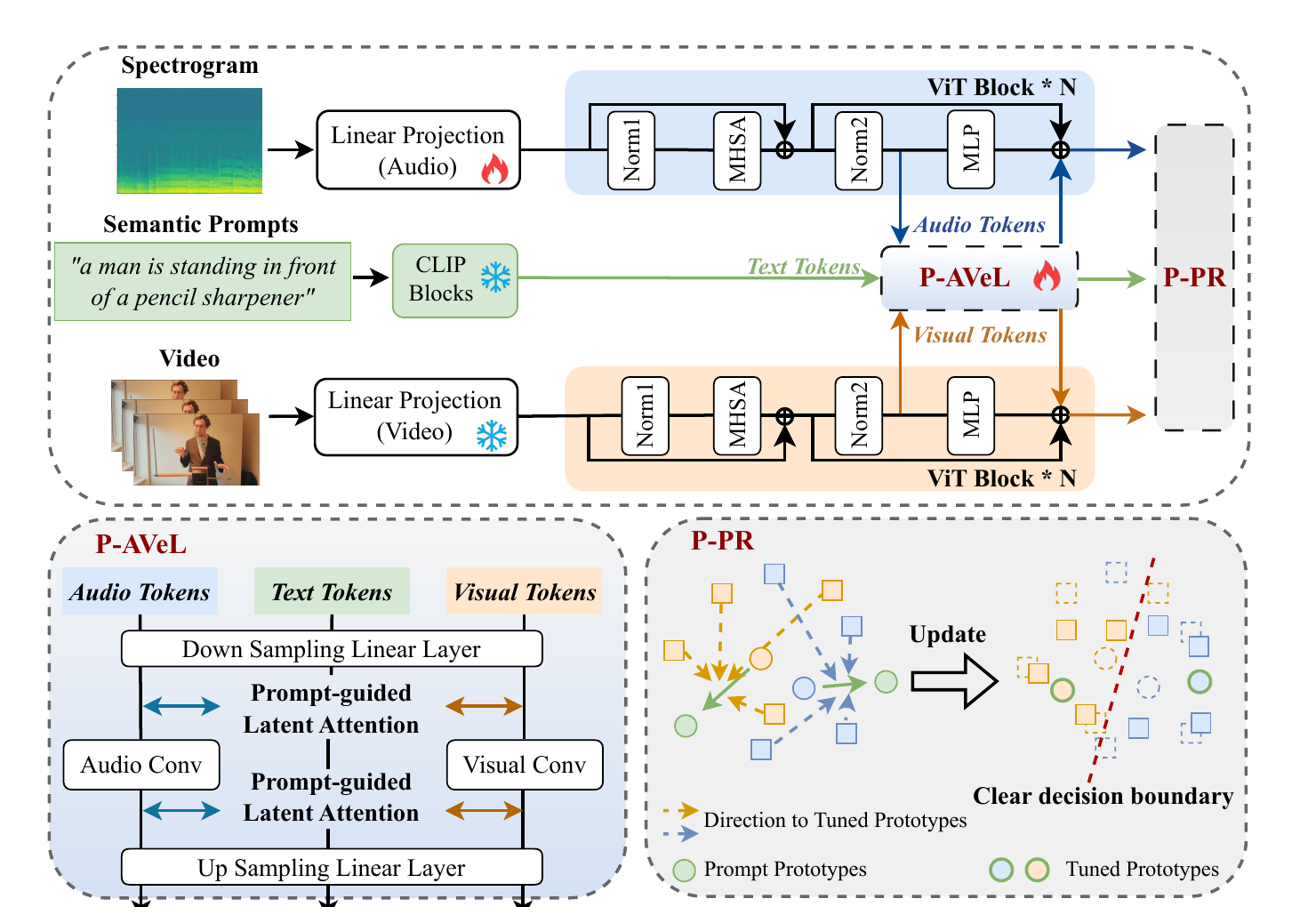
Figure 2 from the published paper: P-AVeL performs prompt-guided audio-visual fusion, while P-PR tunes modality prototypes and the decision boundary.
Core highlights
- Prompt-refined efficient learning: adapter-based modules use prompt-guided latent attention to locate informative tokens in long, asynchronous audio and video sequences.
- Prompt-tuned prototype regularization: semantic centers continuously calibrate audio and visual prototypes and dynamically rebalance the two modalities.
- One framework for three failure modes: the design jointly addresses limited labels, temporal misalignment, and modality bias while remaining parameter-efficient.
The work was published in IEEE/ACM Transactions on Audio, Speech, and Language Processing in 2026.