PhyAVBench
Controlled prompt pairs test whether generated sound changes correctly when one underlying physical condition changes.
PhyAVBench goes beyond audio-video synchronization to ask whether a generation model understands the physical mechanisms that produce and propagate sound. It changes one controlled physical variable in a prompt pair, then measures whether the generated audio responds in the correct direction.
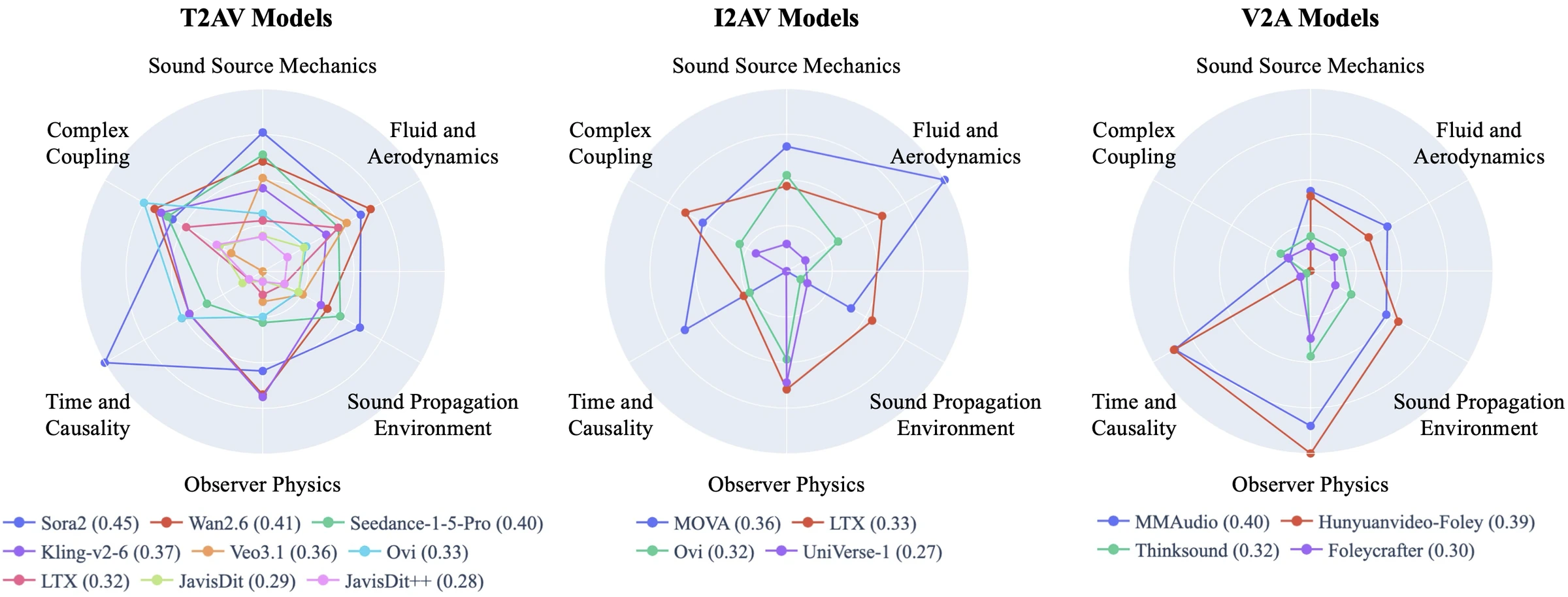
Comparison of generation models across six audio-physics dimensions, from the official PhyAVBench project.
Core highlights
- Audio-Physics Sensitivity Test: separates superficial plausibility from a model’s ability to react correctly to controlled acoustic changes.
- Six physical dimensions: covers sound-source mechanics, fluid and aerodynamic effects, propagation environments, observer physics, time and causality, and complex coupling.
- Grounded in newly collected data: the current public release builds on PhyAV-Sound-11K, with 11,605 videos, 25.5 hours of audio-video, and 184 participants, and evaluates 17 representative models.
I contributed as a core author. The work was selected for an oral presentation at ACM Multimedia 2026.